

Drinking water testing
Water from the public supply can change as it passes through a building's plumbing. Its quality is affected by the materials of pipes and fittings, corrosion, standing water, tanks and water heating systems.
- Sample
- from the tap
- Regulation
- NN 64/23
- Frequency
- as assessed
When to test your water?
For houses and flats, no frequency is set by law: it depends on the plumbing and the risk.
By law
Priority premises
Regular monitoring of the building's water supply network is required by law.
- Renovation or pipe replacement
- Older plumbing or unknown materials
- Change in colour, smell or taste, cloudiness
- Suspected lead, copper or other metals
- Hot water systems (risk of Legionella)
- Long disuse, remediation or a poor result
What is tested
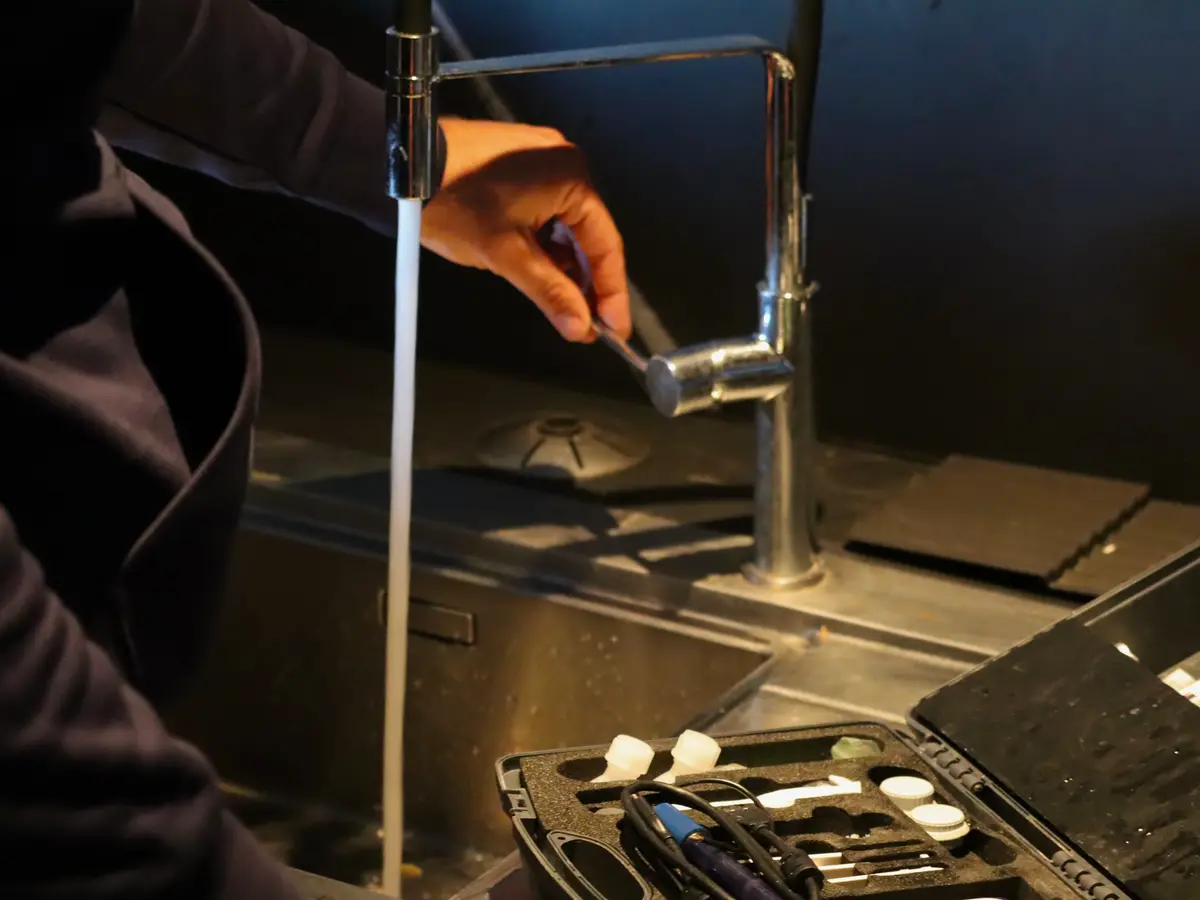
From your tap to the results: we take the samples, the laboratory does the analysis.
We sample at your place
at the tap, where the water is used
We take it to the lab
NZZJZPGŽ
We send you the results
with an assessment of compliance with the regulations
Group A · Regulation NN 64/23, 88/2320 parameters
Physico-chemicallaboratory
- Colour
- Turbidity
- Odour
- Taste
- pH valueHow acidic or alkaline the water is, from 0 to 14 (7 is neutral). It affects how well chlorine disinfects.
- Conductivity
- KMnO₄ consumptionA measure of organic matter in the water: how much potassium permanganate the water uses up.
- Chlorides
- Nitrites
- Nitrates
- Ammonium
Microbiologicallaboratory
- Coliform bacteriaA group of bacteria from the environment and the gut. In water they warn of contamination or poor disinfection.
- Escherichia coliA gut bacterium: in water it means faecal contamination. Safe water has none.
- EnterococciGut bacteria hardier than E. coli: they show faecal contamination, older contamination too.
- Colony countHow many bacteria grow in the laboratory at 22 or 36 °C. A sudden change warns of a problem in the system.
- Colony countHow many bacteria grow in the laboratory at 22 or 36 °C. A sudden change warns of a problem in the system.
- Pseudomonas aeruginosaA bacterium that can grow in warm, damp places such as pools and hot tubs.
- Clostridium perfringensA bacterium whose spores survive in water for a long time, so it also reveals contamination that has passed.
At the sampling pointwhen needed
- Water temperature
- Free chlorineThe part of the chlorine in the water that is available for disinfection. Measured at the sampling point.
Occupancy permittechnical inspection
- Hydrocarbons (C10–C40)Mineral oils, such as petroleum and lubricants. Tested in new builds, for the occupancy permit at the technical inspection.
You get a test report for every sample
For each parameter, the report gives the test method, the maximum permitted value, the result and an assessment of compliance with the regulations.
| Parameter | Method | Maximum allowable concentrationThe limit a regulation sets for each parameter. The report gives it next to every result. |
|---|---|---|
| At the sampling point | ||
| Water temperatureStandard Methods 2550 B | Standard Methods 2550 B | 25 °C |
| Free chlorineThe part of the chlorine in the water that is available for disinfection. Measured at the sampling point.HRN EN ISO 7393-2:2018 | HRN EN ISO 7393-2:2018 | 0.50 mg/L |
| Laboratory | ||
| pH valueHow acidic or alkaline the water is, from 0 to 14 (7 is neutral). It affects how well chlorine disinfects.HRN EN ISO 10523:2012 | HRN EN ISO 10523:2012 | 6.5 – 9.5 |
| TurbidityHRN EN ISO 7027-1:2016 | HRN EN ISO 7027-1:2016 | 4.0 NTU |
| Escherichia coliA gut bacterium: in water it means faecal contamination. Safe water has none.HRN EN ISO 9308-1:2014 | HRN EN ISO 9308-1:2014 | 0 / 100 mL |
| EnterococciGut bacteria hardier than E. coli: they show faecal contamination, older contamination too.HRN EN ISO 7899-2:2000 | HRN EN ISO 7899-2:2000 | 0 / 100 mL |
MAC: maximum allowable concentration under the Croatian regulations on drinking water (NN 64/23, 88/23)
Contract partnerTeaching Institute of Public Healthof Primorje-Gorski Kotar County
Frequently asked questions
How often should the water in a house or flat be tested?
For houses and flats, no frequency is set by law: it depends on the plumbing and the risk. Regular monitoring of the building's water supply network is required by law for priority premises.
When is it a good idea to test tap water?
After renovation or pipe replacement, with older plumbing, when the colour, smell or taste of the water changes, if you suspect lead, copper or other metals, and after a long period of disuse or a poor result.
What is tested in drinking water?
We test the water quality parameters (group A) under the Croatian regulation NN 64/23, 88/23: physico-chemical ones, such as colour, turbidity and pH, and microbiological ones, such as Escherichia coli and enterococci. The analysis is done by the Teaching Institute of Public Health of Primorje-Gorski Kotar County.
Should hot water be tested too?
Hot water systems carry a risk of Legionella. We test hot and cold water in buildings for Legionella as part of our Water systems service.
Water systems testing
- Contact person
- Linda Petrović
- Phone
- +385 91 347 63 41
- info@czmv.hr
- Office
- Žegoti 36, 51215 Kastav